

European Spatial Data Infrastructures: A Time of Change

Summary
As part of the competitiveness and simplification political priority of the EC, the INSPIRE Directive will be “simplified”, with the biggest change being the removal of all requirements related to interoperability of data and network services from the legal text itself. Metadata and scope remain more or less unchanged.
It is also to be aligned to horizontal legislation such as the Open Data Directive, the Digital Union strategy and the Interoperable Europe act.
The relevant changes are set to occur in three phases:
- the change to the legislation, which has been published in December 2025 and expected to enter into force in late 2026;
- the publication and implementation of a “non-legal, practical measures/toolbox”, which is to happen in 2026 and 2027;
- the creation of potential new “core geospatial framework” legislation as well as other instruments, which is to happen in between 2028 and 2029.
This article summarizes the proposed changes and aims to put them in the wider context of current legislation, challenges and opportunities. It also provides a strategy for INSPIRE implementers on how to best proceed given this transition.
Webinar Recording
wetransform organised a webinar about the upcoming changes on March 19th, 2026.
The recording of this webinar, hosted by wetransform CEO Thorsten Reitz, is available on YouTube.
If desired, the slide deck from this presentation can be downloaded here.
The Why and and What of the Changes
INSPIRE: Did it succeed?
In the past years, the European Commission has evaluated the INSPIRE directive using several instruments, ranging from studies to participatory policy labs. The objective was to see if the INSPIRE directive was efficient in reaching the policy goals of significantly improving access to and usability of geospatial and environmental data.
The findings of this evaluation included:
- Even after the end of the INSPIRE implementation guideline in 2021, data availability often remains patchy, and data quality is not homogeneous enough.
- There are substantial costs related to implementing INSPIRE, especially related to data harmonization and the operation of network services.
- There is friction in data access and usage, especially with core geospatial user groups, and compliance with all Implementing Rules (IRs) and Technical Guidance (TGs) helps little with easing that friction.
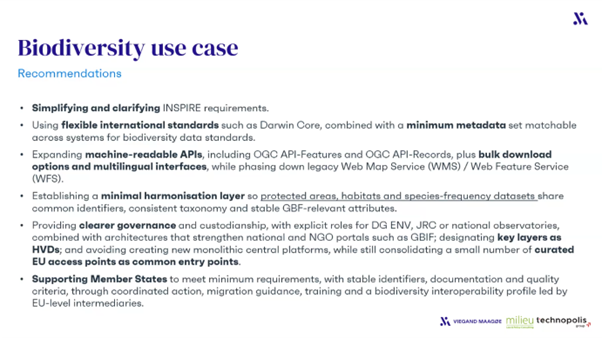
Figure 1: Recommendations for more effective data provision for the Biodiversity domain from a recent INSPIRE evaluation study
Key recommendations included:
- Establish a more flexible and inclusive governance structure that also represents data users, data processors and data intermediaries
- Create a less rigid legal structure that would allow said governance to quickly adapt technical guidance and infrastructure to current requirements
- Re-use common, well-supported standards instead of custom extensions and de jure standards that have insufficient support with key stakeholder groups
- Align with newer legal acts such as the Data Act, Data Governance Act, Open Data Directive/HVD and especially with new initiatives such as GreenData4All and the Green Deal Data Space (SAGE).
- Protect existing investments into Spatial Data Infrastructures (SDIs) and retain semantic interoperability resources (e.g. code lists) and requirements.
Together with the JRC, I also did a study to assess the impact of INSPIRE regulations on interoperability, which was published in late 2025 and can be found here.
The Proposal
Loosely based on these results, the European Commission has proposed a significant amendment to the INSPIRE directive, which was published on 10th of December. This amendment claims to simplify the directive based on the feedback from the evaluation and aims to align it with data legislation that has since come into force.
This proposal retains the scope of INSPIRE, which means that it is still required to make data sets falling under one of the 34 INSPIRE themes findable and accessible. Data sets still need to be published, they still need (ISO) metadata.
Other than that, the proposal removes most of the obligations that defined the INSPIRE Directive:
- Requirements related to interoperability of data (Article 7 and 8)
- Requirements related to interoperability (Article 11 and 12) and performance (Article 16) of Network Services, which means that the only remaining regulation is that of the High Value Datasets Implementing Act (HVD) to use “APIs” and “bulk download”.
- Requirements to make data available free of charge (Article 14) and for reciprocal sharing among INSPIRE implementers (Article 17), which is an alignment to the rules of the Open Data Directive
- Requirement to operate a central INSPIRE Geoportal (Article 15); data will instead be catalogued in the EU Open Data Portal
- Member State obligations related to the monitoring and reporting (Article 21), which is instead handled via the processes established for the Open Data Directive and the High Value Datasets Implementing Act.
The proposal also introduces some changes to the possible legal and governance structure, such as allowing future implementing acts to establish standards for interoperability and for metadata. This is done in several places throughout the proposal. An example for this is Article 5, paragraph 4:
“The Commission is empowered to adopt implementing acts laying down rules for the application of this Article, taking account of relevant, existing international standards and user requirements, in particular with relation to validation metadata.”
Article 13 (1), which handles access to sensitive spatial data sets, is also updated, but does not seem to make an explicit reference to the Data Union Strategy or to Data Spaces.
The final changes can be found in Article 22, which are mostly procedural. The updated article misses the opportunity to empower the governance structure to fill the gaps left by removing interoperability requirements and to make it more inclusive.
There are no changes that directly align the amended Directive to align with the Interoperable Europe Act, or to the (updated) Data Act(s).
Further Process & Timeline
The current proposal has been drafted by the Commission and has been adopted by the College of Commissioners. After this step, the Commission transmits the proposal to the European parliament, the Council, and the national parliaments. From that moment, the proposal enters the EU legislative phase. Parliament and Council examine, amend and negotiate it under the usual legislative procedure.
According to the EC, this process will likely be completed in late 2026. There will then be a transition period of 12 months before it enters into force, and there will also be a transposition period of 12 months – this being a directive, it has to be implemented into national law. And, in federal state such as Germany, it will probably also have to be transposed to state law. This means that in late 2028, we can expect these new regulations to be fully in effect.
The EC has furthermore announced that in a second phase, going from 2026 to 2027, there will be a “non-legal practical measures toolbox”. According to EC representatives at the GreenData4All meeting on 20.01.2026, this toolbox is to enable “practical reuse of environmental and geospatial data through standards, digital tools, and community initiatives, focusing on priority use cases and clear added value”. At the same meeting, the EC indicated that building this toolbox might be supported through tenders and grants. A key part might be establishing Data Trustees or Intermediaries and implementing such priority use cases on the foundation of the Common European Data Spaces, especially the Green Deal Data Space.
Finally, the EC (specifically DG DEFIS) has published a tender titled “Comprehensive policy framework for core geospatial data in the EU”. This tender asks for:
- the evaluation of current policy such as INSPIRE,
- to draft recommendations for new legislation
- that ensures that data from 14 INSPIRE themes is available across the EU,
- in a truly interoperable, fully harmonised form,
- which can easily be combined with Copernicus data to support crucial policies, e.g. in the resilience domain.
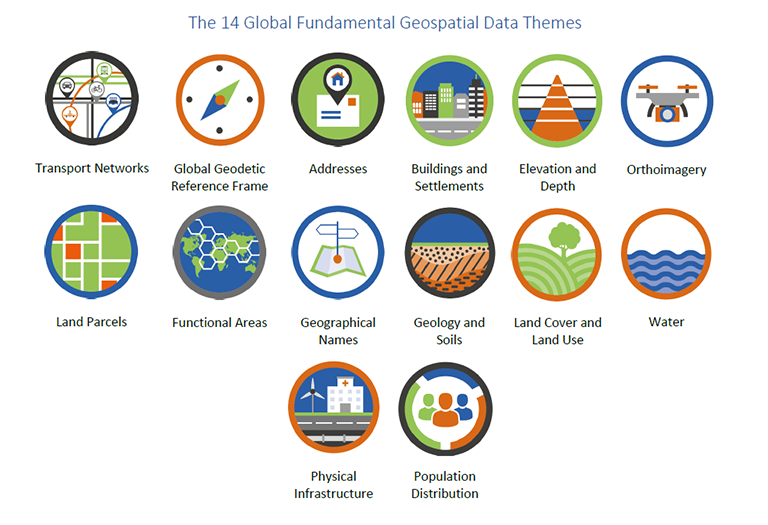
Figure 2: Icons depicting the 14 global fundamental geospatial data themes
The project to define this potential new legislation would end in late 2027 and would enable the EC to set up a new legal framework for this purpose in 2028. With the usual timelines, this means it would go into effect in 2030 to 2031, a few years after INSPIRE has effectively been switched off.
First Impacts
Even though the EC has not formally adopted the changes yet, and thus INSPIRE is still in force, it has already made operative decisions. Most of the common INSPIRE infrastructure is switched off in 2026:
- INSPIRE Reference Validator: central instance will be switched off on 31.03.2026. No replacement planned.
Note: If you do need a validator instance, let us know, we will keep running ours as long as it is safe to do so.
- INSPIRE Geoportal: will be switched off on 30.06.2026, data.europa.eu is supposed to replace it as the central access point.
- INSPIRE Registry: Will also be switched off on 30.06.2026. A migration to the EU Vocabularies VocBench infrastructure is planned.
Some knowledge infrastructure and technical documentation is to be maintained and published by the JRC at least until end of 2026. How these artifacts, good practices and other information will be maintained will be decided by the INSPIRE Maintenance and Implementation Group (MIG).
While removing requirements from the legal act itself would allow a much more flexible governance of the standards and requirements, removing them entirely without some form of empowerment of the governance or statement of objective will likely lead to much lower accessibility and usability of data, and can be expected to happen soon.
It is also in contrast to findings of multiple evaluation studies, which all suggest that retaining and improving interoperability is essential for critical use cases ranging from Environmental Impact Assessments to Water Resilience, Biodiversity or supporting environmental reporting, the Nature Restoration Law and many more.
My View
Without doubt, there were some construction errors in the ambitious, first-of-its-kind legislation that INSPIRE is.
To me, the single biggest problem was that it wasn’t immediately enforced to implement the more than 90 environmental and related policy reporting and statistical data flows on top of INSPIRE. Only very few, such as the Environmental Noise Directive, have been aligned to INSPIRE. It would have made the value much clearer, created a once-only infrastructure almost two decades ago, and would have created massive synergies.
Other issues included the “accidental” technical complexity that came from building on ISO 191xx standards, reliance on custom extensions to these standards, the inflexible legal framework and the slow governance processes that made adaptation slow for a significant period. All of this was pointed out by the various studies evaluating INSPIRE as well.
My main problem with the proposal as it stands now is that it implements only one of the six main recommendations following the evaluation, and that it makes no attempt to protect any investments that have been made by those who implemented INSPIRE.
Here are some specific comments on proposed policy changes, the outcomes of the evaluation and their impact:
Removing data interoperability requirements (Article 7 and 8): While superficially addressing the complaint that harmonization creates high efforts, all evaluation studies found that interoperability is highly desirable. Core interoperability mechanisms have to be retained if Geospatial and Environmental data are to be made useful as part of the Data Union, and in support of the dual transformation of the European Union, and especially to build world-class AI solutions.
Removing requirements related to interoperability of Network Services (Article 11 and 12): This mostly creates flexibility, and since the HVD IA still requires APIs, it is not as damaging. What I would expect here is a paragraph that delegates the responsibility of managing good practices and other technical standards that enable interoperability to the governance structure of INSPIRE.
Removing requirements related to performance (Article 16): It is not clear why it would be of interest to reduce the reliability standards of the European SDI, and to my knowledge, this was not recommended in the evaluations. Thus, I think it makes no sense to completely remove the Quality of Service requirements in an age of AI and the Data Union. They could easily be decoupled from the Directive and from concrete implementation, and at least aspects such as availability and capacity could be retained or updated.
As it stands now, this proposal will damage the European Spatial Data Infrastructure. There is no doubt that this will reduce accessibility and usability of environmental and spatial data dramatically. In some cases, unharmonized data will remain online as Open Data, but it’s data model and lineage is undocumented and hardly ready to be used for key use cases. Without any obligation to use common standards, we will see further fragmentation.
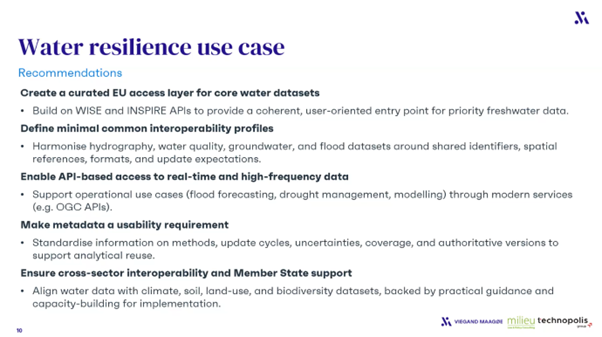
Figure 3: Recommendations from the Water Resilience use case. Note the importance of interoperability.
Now more than ever, a strong interoperable data foundation is needed – for AI, for the Data Union.
To achieve that, we need to:
- Retain the objective for semantic harmonisation of core properties within all INSPIRE themes that are HVD IA, as an actively governed foundation for other legal acts such as Intelligent Transport Systems (TN-ITS) and the European Noise Directive (END)
- Clearly specify where the future governance will live and what it needs to achieve, giving a clear mandate to create interoperability and to enforce it
- Make that European Spatial and Environmental Data Governance more agile and inclusive, explicitly including intermediaries & the EEA for example,
- Make it clear what the relation to the Green Deal Dataspace is going to be (which is mentioned a lot in the preface, but never in the actual amended INSPIRE Directive)
- Provide a bridge to a potential future SDI as implemented on the basis of the novel "core geospatial legislation framework"
- Connect the updated INSPIRE directive 2.0 as a foundational component of the collection of data for the EU Biodiversity Strategy as well as for indicators used in the Nature Restoration Law (in addition to any measurements coming from Copernicus) and other legislation and initiatives
- Provide regulatory and financial incentives for creating (cross-border) interoperability and for creating synergies (Once Only Principle etc.)
I think there is a middle ground between prescriptive legislation such as the INSPIRE Implementing Rules and not requiring anything: The legislation could state that the governance structure is responsible for establishing rules that enable interoperability that is sufficient for (list of key use cases) and ensures (e.g. accessibility, findability, semantic interoperability of key variables...).
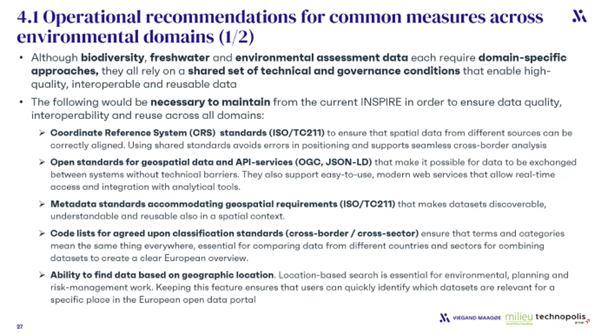
Figure 4: Overall recommendations from the GreenData4All INSPIRE evaluation study
A Guide for the Next Steps
So, if you are an INSPIRE implementer currently running infrastructure, what should you do?
- As of today, no obligation has changed, and the current rules will stay in effect until at least late 2027. Often, this timeline will be longer due to the required transposition into national and state-level legislation. This means that network services must still run. This is especially key if your network services are actually accessed (see figure 5 below).
- It also makes sense to keep existing assets running until it is clearer what the non-legislative package and the potential new legislation for core geodata will look like. Especially the latter is likely much easier to implement if you already did your INSPIRE homework. Immediately switching off stuff will mean you will have to start from scratch in two or three years.
- At the same time, it is clear that harmonisation work towards the INSPIRE schemas can at least be paused until the EC and the MIG-T have defined a strategy about how to ensure interoperability in the future. Use-case specific harmonisation work still makes sense, and aligning semantics to commonly accepted codelists is still very valuable.
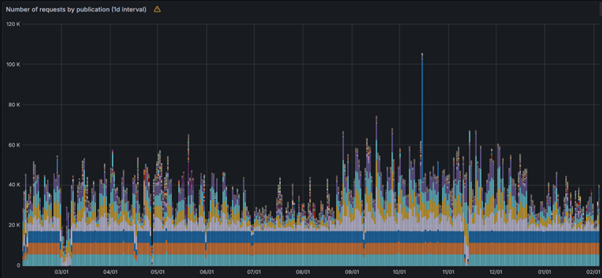
Figure 5: A year of requests on INSPIRE services of a small organisation, top 10 services had around 2M requests to them in the last year
Outlook
If the EC manages to not just remove the core of INSPIRE, but actually manages to properly support the creation of the Green Deal Data Space through incentives, investments and other legislation, properly supports the creation of data trustees and intermediaries, and manages to create a clear transition path for INSPIRE interoperability governance from the current structures to those under Interoperable Europe, we might have much better data accessibility and useability in our domain in a few years. The main risk, however, seems to be the uncertainty of the transition.
In any case: At wetransform, we will stay committed to data interoperability and usability. We are ready to create new interoperability mechanisms. We will stay true to our mission of empowering communities by providing open, high-quality, and interoperable data that drives informed decision-making. Because when we stop observing the world, we become blind and unable to decide on the way forward.